
All articles
AI Moves Personalization Past Segmentation Toward The Customer Of One
Fortune 50 CMO Rohit Prabhakar makes the case that connected data, AI agents, and trust move personalization past segmentation to the customer of one.
Make The CMO Wire one of your go-to sources on Google

Segmentation asks which group you belong to. Personalization asks what you need right now.
Personalization ranks among the priorities that marketing, data, and privacy leaders name most often, yet the versions consumers encounter still land as generic. A shopper with years of loyalty and hundreds of orders can receive the same welcome discount written for a first-time stranger. Advances in machine learning, generative models, and agentic systems are opening a path toward experiences built for one person at a time, powered by connected data and earned trust. Where a brand once organized its audience into cohorts, it can begin to consider what a single customer needs at a given moment.
Rohit Prabhakar has spent his career building customer experiences across payments, healthcare, and information services, work he credits with generating $1.7 billion in measurable value. A Fortune 50 CMO and CDO whose earlier roles include Visa and Thomson Reuters, he now writes and advises under a framework he calls Market of One. Much of his current thinking centers on what he terms customer singularity, the point at which technology can serve one person as precisely as it now serves a segment.
"Segmentation asks which group you belong to. Personalization asks what you need right now," Prabhakar says. Sorting customers into buckets was long the affordable option, and he sees that convenience as the root of the disconnect consumers feel as their expectations climb. A person gets filed under a demographic label and then absorbs a stream of messages meant for the label while the individual behind it goes unseen. He points to a handful of companies that have made it work, from Amazon's familiarity to Netflix's sense of taste to Stitch Fix's millions of outfit combinations, while most of the industry has spent heavily on technology and headcount without catching up. "Netflix understands me as a human. How I behave, what I like, what I don't like," he notes.
The machinery underneath
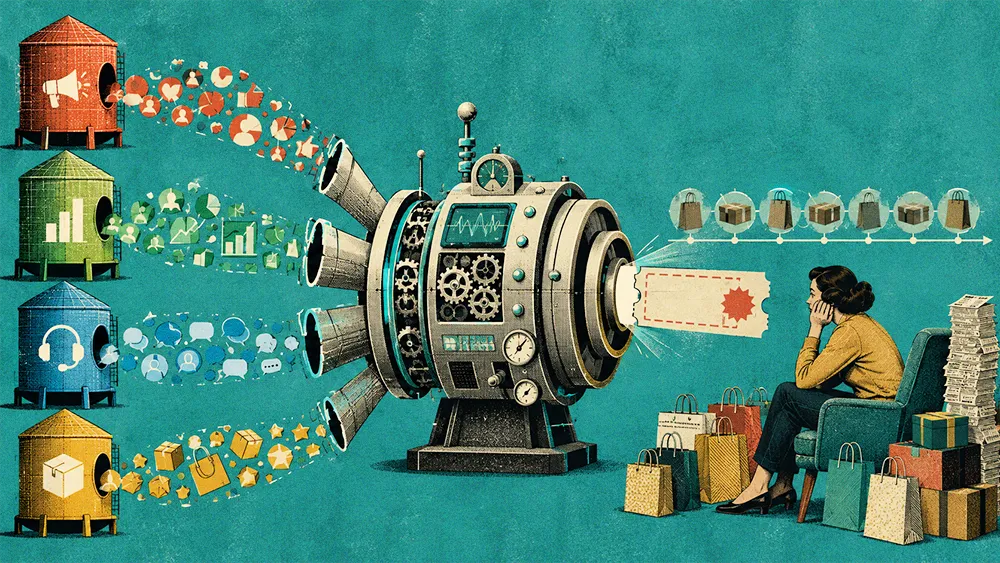
Prabhakar is careful to separate ambition from execution. Most teams already know what a good experience looks like, and he holds that the gap shows up only when that vision has to travel through the machinery that delivers it. "The problem isn't the strategy, it's the system. Most companies have the right intent, but the entire system is broken," he explains.
His Market of One framework replaces that machinery with a set of cooperating agents, each doing a distinct job. One perceives who the customer is, a second reasons about where they are in their journey, and a third builds the experience for them. A fourth holds memory, the history and continuity across those steps, and a fifth governs ethics, the boundary on what should and should not be personalized. Everything downstream depends on that first job, and it's the one most organizations get wrong. "Bad data in, bad experience out," Prabhakar notes. "Most companies don't even know their customer because their data still lives in silos."
Prabhakar traces the silo problem to leadership more than technology. Many companies have hired a chief data officer, yet the mandate handed to that role tends to align with a single commercial priority and stops short of the whole customer journey. He holds that connecting data across marketing, sales, service, and product has to become a board-level and CEO-level directive, backed by a shared commercial goal and a multiyear commitment. Without that push from the top, he sees the work fragmenting into the same disconnected efforts that have stalled for two decades.
Economics change the math
The reason one-to-one experiences historically stayed out of reach was often arithmetic. Producing content and creative for every combination of customer and moment once required an army of writers and designers, which no team could staff. Generative models now absorb much of that production load, and the cost of running them has fallen sharply. A single personalized experience that might have cost hundreds or thousands of dollars a year ago could soon cost a fraction of that. "The cost of serving 100,000 versus serving one becomes almost identical," Prabhakar says.
As that math changes, the work itself changes. Prabhakar describes a role built around direction more than production, closer to a coach than a maker. In the early years, he compares it to supervising a self-driving car, correcting the system, showing it what good looks like, and moving over time from proofreading to oversight. "The marketer of the future won't spend their time building campaigns," he explains. "They'll spend their time training AI systems to create the best possible customer experiences."
Prabhakar is candid that the industry is not there yet, and that the campaign remains the default for now. He views the current wave of martech as unsuited to continuous, one-to-one delivery, and expects a new generation of products to emerge as costs fall and agentic systems mature. Somewhere between one hundred and two hundred companies, by his estimate, are already building toward it. He also cautions that leaders need proof before they pivot, a working pilot that shows the art of the possible before anyone believes it.
Trust makes the loop work
For all the emphasis on capability, Prabhakar keeps returning to restraint. Powerful personalization can just as easily overreach, which is why an ethics agent belongs inside his framework alongside the ones that perceive and act. He treats consent as a requirement designed into the system from the start. "There has to be a limit to what can be personalized," he says. "One hyper-personalized experience that makes the user feel you know too much about them, and you lose the trust and the customer."
Prabhakar believes trust is what earns a brand the right to keep learning about a customer. People rarely unsubscribe from the brands that started with a genuine need, asked for consent, and gave value back before asking for more. Most marketing never sets up that exchange. "Marketing today is still a loudspeaker. Brands are speaking, not listening," he concludes. "The future is a continuous feedback loop built on trust, where every interaction makes the next experience better."
The views and opinions expressed are those of Rohit Prabhakar and do not represent the official policy or position of any organization.