
There has to be some scale in that personalization. You can't personalize for each individual. You can personalize for cohorts, you can personalize for groups of similar identity, and that's the approach that we tend to take.
 Kunal MehtaGlobal Head Marketing, Communication and Brand, dsm-firmenich Animal Nutrition and Health
AI has made B2B marketing teams faster and cheaper at producing almost everything they publish. Some of that output still needs a human touch, because brand consistency, compliance, and the trust behind a long sale all depend on judgment. A marketing leader then has to divide the work between an agency, an in-house team, and technology. The split decides how much of that work can scale, and how much of it still depends on time spent with the customer.
Kunal Mehta is Global Head of Marketing, Communication and Brand for dsm-firmenich's Animal Nutrition and Health business. There, he leads the global brand management, digital marketing, marketing communication, event marketing, media, and design teams, and sits on the group's brand council. Mehta spent eight years at Nestlé, where he ran global innovation for KitKat from the company's headquarters. He handled the South Asia chocolate portfolio before that, and worked in product management at Britannia Industries earlier in his career.
"There has to be some scale in that personalization. You can't personalize for each individual. You can personalize for cohorts, you can personalize for groups of similar identity, and that's the approach that we tend to take," says Mehta. His customers run from individual farms and feed mills to integrated producers, and further along the chain to retailers and packaged-food companies. Grouping them by what they have in common is how his team covers that range across several countries.
Automation and its limits
The animal nutrition business sells multiple product lines. Each competes with the others for the same money, the same hours, and the same room on a social platform. "When you are a multi-product company, you have only that much in terms of space, whether it's time, resource, budget or even space externally on social media platforms. How can you satisfy all these different stakeholders?" asks Mehta. "In some sense AI has been helping, digital tools have been helping, automation has been helping."
Animal nutrition is a regulated category, and a sentence about performance can read as a claim whether or not it was meant as one. "In the kind of company we operate in, regulatory-wise you have to be very careful with what we're saying and what we're not, and AI can misinterpret that sometimes," explains Mehta. "Human in the loop still plays a very critical role in terms of making sure that everything that's going out there is true and authentic, and also it's consistent in terms of building the brand."
Dividing the work
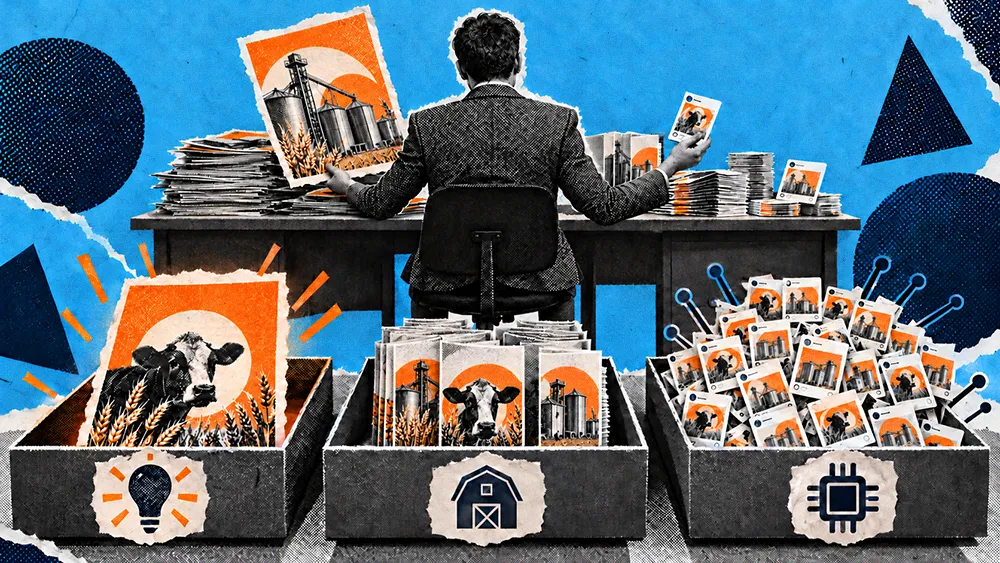
Mehta sizes each product's budget against existing business, its growth potential, and where the industry is heading. The bigger products get more, and each piece of work then goes to whichever of three places is best equipped for it. "When you're doing a new launch, you want to come up with a core creative concept which can then help in building the value proposition. To do that we like to work with external strategic agencies that have great experience, fantastic people, exposure across multiple industries," says Mehta. "Once that core concept has been cracked, I have an in-house graphic design team. I don't need to spend the same amount of money with an external agency partner. If we need to scale up social media content or different copies and different visuals, that's when the technology comes in and helps."
The line between agency, in-house, and technology moves with the workload. A launch pulls the work outward, and Mehta resets the split on judgment and whatever time and money allow. "There might be times when we feel that no one else knows the business better than the people who have been around in the business. Technology doesn't know it, external people have a limited viewpoint, and therefore we need to dial up the inputs from our own teams," he notes. "There might be a possibility that we decided to do a social post with the help of technology, and we see it underperforming. Either we need to train the machines, which means that again the teams get involved, or we need to take it back to the teams in house."
Same product, different lenses
A customer's segment decides both the message and where it gets sent. Themes like performance and profitability travel across all the segments, and the nuances inside them are where personalization, account-based marketing, and email nurturing come in. "We're also trying to understand the behaviors of different segments and what needs to be in terms of retargeting, what kind of content is important for what kind of profile and persona," says Mehta.
A buying committee for a single product can include people whose jobs have little in common, and what each one wants to know about it differs accordingly. "The procurement guy wants to hear more about what is in it for him or her in terms of profitability and pricing. The sustainability guy wants to know what you're doing from an ESG point of view and how you're making sure that whatever you're doing is helping in terms of emissions or planet," explains Mehta. "It's the same product, but you need to then define and communicate with different lenses."
Trust built in person
A sale that needs an entire team behind it takes time to come together, and Mehta spends that time in person. He works through a customer's business one group at a time, and the company commits once every group is convinced. "Those relationships can't be built through AI or through just being behind the screens. You need to be with the person, physically knowing them, having a dinner with them, having those kind of conversations," says Mehta. "That collective confidence cannot happen through just putting out a social media post."
Customers tell Mehta that the occasions they value are the ones where his team comes to them. Customer experience and events sit inside his team, so those occasions are his to create. "When their account manager would come and sit and spend time with them, they felt heard. They felt they understood their problem while spending time on their farm. When they would come to our trade shows or our exhibitions, they could see how we're thinking about science, innovation, technology," he says.
dsm-firmenich's recent World Nutrition Forum brought 600 delegates to Kuala Lumpur, flying in from four continents. The official program is centered around talks, but the evenings that follow are where the relationships form. "This is just one example of showing why offline still matters so much," Mehta concludes.