

All articles
Agentic Shopping Is Rewriting Retail’s Funnel. Brands Need More Than First-Name Personalization To Keep Up.
Mind Over Media's CEO, Andy Anderson, argues that the brands winning in agentic commerce won't be the ones with the cleanest data, but the ones already learning from every customer conversation.
Make The CMO Wire one of your go-to sources on Google

"Nobody has a conversation with their customers at scale. Now you have the ability to have that conversation using AI. From that, you will learn more about your business than any amount of guesswork you could compile internally."

Online shopping has lost its plot. Shoppers move through endless product grids, second-guess sizing charts, and click "buy" with no real confidence they got it right, while returns climb and loyalty stalls. Meanwhile, brands sit on years of useful customer data and send emails that personalize a first name as their strategy. More data than ever, and brands have never been worse at reading it.
Andy Anderson is the CEO and Co-Founder of Mind Over Media, which builds omnichannel AI personal shopping agents for direct-to-consumer brands across sports, entertainment, and the creator economy. He has driven more than $300 million in entertainment DTC sales across movie tickets, merchandise, and in-game purchases, and spent nearly eight years as a senior executive at DMG Entertainment marketing and distributing Hollywood blockbusters like Iron Man 3 for Chinese audiences. The through-line across that work is the same thing he's building toward now: figuring out how brands have meaningful conversations with their customers at the scale modern retail demands.
"Nobody has a conversation with their customers at scale. Now you have the ability to have that conversation using AI. From that, you will learn more about your business than any amount of guesswork you could compile internally," Anderson says. His argument is that most retail AI never graduated from automation. It got comfortable being an answer engine, and brands let it.
The first-name fallacy
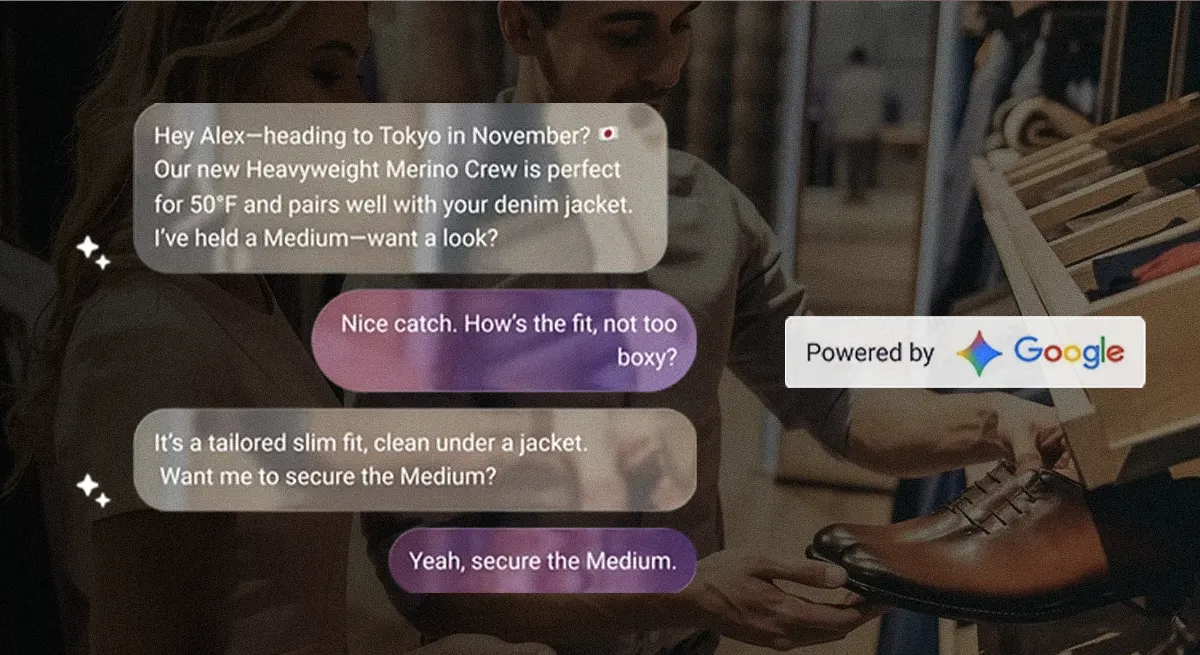
The industry's default version of personalization is "an email blast that also includes my first name," Anderson explains. It looks individualized but it's just a broadcast with a name field. Real personalization means tracking where someone shops, what they buy, when, and what they circle for weeks without pulling the trigger. That last signal is pure intent, and most brands let it evaporate.
Early retail chatbots made the problem worse. Anderson describes them as "predetermined messages that push you towards what the brand hopes you're asking." Shoppers get funneled through scripts that can't adapt, can't learn, and torch the one signal the brand should have been collecting.
That's the paradox of legacy automation. It looks like progress, but it prevents the kind of learning that makes AI valuable in the first place.
The readiness excuse
For teams that recognized the problem, a second obstacle emerged. A widely repeated narrative took hold across enterprise retail, telling teams they needed to spend years cleaning and restructuring their data before deploying AI in any serious way.
Anderson has watched it spread. "I think that has slowed enterprise down from adopting AI earlier," he says, adding that overwhelmed operators often felt genuine relief when told their data simply wasn't ready yet.
That relief came at a cost, because modern AI tools handle unstructured data well, and getting started requires far less data hygiene than enterprise teams were told. Anderson isn't dismissive of the operational reality facing retail leaders, who juggle warehousing, supply chain disruptions, and macroeconomic pressure. He draws a line between real constraint and a convenient excuse. The longer brands wait, the further behind they fall against competitors already redesigning their operating models around AI.
Running on hope
That delay shows up in how retail teams measure performance. Media spend, site visits, clicks, initial purchases, and then, Anderson says, "hope" for repeat business. A 2.5 percent conversion rate has become an industry norm that quietly accepts the failure of everything that came before it.
Agentic shopping is breaking that model in real time. More product discovery is moving into ChatGPT, Perplexity, and Gemini, and the shopper still has to click out to a brand site to actually buy. That break is where the conversation ends. Some retailers are experimenting with in-environment checkout to close it, but most brands still lack a mechanism to learn from those interactions. The platform owns both the discovery and the signal, while the brand only gets the order.
"I don't think we yet appreciate how fast companies that use AI will also move," Anderson says. "If I'm trying to remain competitive in my space, I would be trying to remove as many legacy systems as possible and replace those with as many trusted AI systems as possible."
The proprietary data play
Speed alone isn't the goal. Anderson's framework starts with running internal experiments so teams build AI literacy before building anything customer-facing. Follow this up with low-stakes deployments that prioritize what most retail programs are missing: talking with customers at scale.
Those conversations yield much more than qualitative feedback. As AI operates across functions such as support, discovery, recommendations, and post-purchase, the data it generates becomes a proprietary asset. "It's your absolute single source of truth, and it is the most knowledgeable thing in the entire organization," Anderson says. That asset can inform product assortment, pricing, and messaging in ways that no survey or focus group ever could, and the value grows with every interaction.
The most common failure he sees is treating a single large language model as the whole solution. Without a multi-layered architecture, including guardrails, cross-checks, and brand voice controls, the technology behaves unpredictably. With the right structure in place, it stays on-brand and expands into more channels with confidence. For teams still building internal trust, controlled pilots are the fastest path to both.
The store that knew your name
The technical argument keeps circling back to a human one rooted in how retail used to feel. "You walked into your favorite store. The person knew who you were. And you worked with that person to find great things, and you walked out with something that you were really proud of," Anderson recalls.
People still want that experience. Scale made it impossible to deliver, and conversational AI is the first real infrastructure capable of returning it without an extensive human team. When it works, customers buy with more confidence, spend more, and come back.
Anderson is clear-eyed about what AI won't do. It won't replace human judgment or make strategy unnecessary. The question he's more interested in is whether AI can make buying online feel less like a chore and more like being helped. He thinks it can. "If we could just let the computer act like a computer, and we could go act like humans, then I think that would be a pretty cool world."