
All articles
The Next Platform Shift: From Feature Stacks to Autonomous Execution Built for ROI
Attentive CSO Eric Miao says the current era of marketing technology has hit a ceiling, and the path forward depends on platforms that act on a marketer's behalf.
Make The CMO Wire one of your go-to sources on Google

Building more features isn't the answer anymore. Technology that can make decisions and personalize messages for marketers at scale is where the real value is.

For years, the martech industry's answer to every challenge was another feature, another dashboard, another workflow. Now, the more compelling question is no longer what tools marketers have access to, but how much of the work those tools can do for them.
Eric Miao, Chief Strategy Officer at Attentive, has seen the problem up close. With prior experience in mobile marketing at Twitter and TapCommerce, Miao has spent the last 10 years watching the same pattern repeat: marketers gaining access to more tools and still losing customers and revenue to their competitors.
Personalization is the Future of Marketing
Three years ago, that observation pushed Attentive to double down on AI, building technology designed to act on a marketer's behalf rather than adding to their workload. "Building more features isn't the answer anymore. Technology that can autonomously make decisions and personalize messages for marketers at scale is where the real value is," Miao says.
The money box: Miao frames customer engagement and retention as a financial engine. As acquisition costs climb across paid channels, the discipline of deepening relationships and driving repeat behavior determines whether those investments pay off over time. "You put a dollar in, and you get $5 or $10 out. CRM is how you make sure the lifetime value is actually good enough to make that spending worthwhile," he says. Extracting that return takes consistent, personalized execution at scale. Most programs stall when teams treat retention as a campaign cadence rather than a continuous practice of understanding each individual customer well enough to anticipate their next move. The opportunity sits with leaders willing to operationalize that understanding inside the programs they already run.
The personalization paradox: For years, the standard has been personalizing by segment, but that breaks down when so many customers belong to more than one or the number of segments gets too large. A single shopper buying a coat for herself and a gift for her son lands in two segments at once. "Marketers end up producing many times more content, building audiences that are supposed to stay mutually exclusive, and scrambling to stage them when they inevitably overlap," he says. The practical result is that most marketers default to broad rules that work most of the time rather than personalized strategies that work every time.
Expanding Understanding of Lookalike Segments
For years, segmentation has relied on recency, frequency, and monetary value, a model that sorts customers into broad buckets but can only account for their activity with a single brand. AI can see beyond it, identifying patterns and signals that fall outside any marketer-defined segment and surfacing high-value prospects that traditional models would never find.
The closet conundrum: Traditional segmentation only sees what a customer has done with a single brand, which can be deeply misleading. A customer who owns one item from a clothing brand may look like a low-value prospect on paper while spending heavily on apparel elsewhere. "Based on that single data point, the brand might assume I'm not a valuable customer. But the reality is, I buy a lot of clothes. Just not from them," he says. The gap between what a brand can see and what is actually true about a customer is where significant revenue gets left on the table.
The signal beyond the purchase: Closing that gap means looking past transaction history to the broader signals a customer leaves behind. Device type, browsing behavior, location patterns, and timing all carry information that purchase data alone cannot. "Someone who just bought a new iPhone is telling you something about the brands they trust and the quality they expect, even if their purchase history with us doesn't reflect that yet. That's a signal worth acting on," he says. The same logic applies across dozens of data points that never make it into a standard RFM model but consistently predict how a customer is likely to behave.
Focusing on Relevance to Drive Conversation
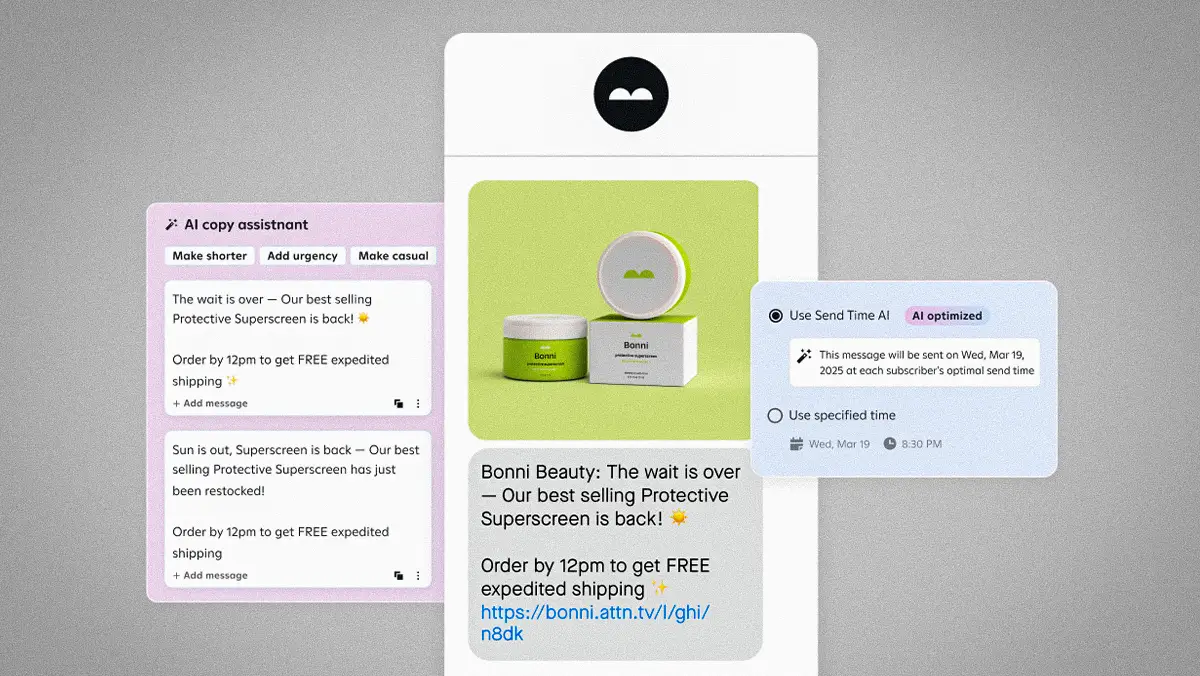
Augmenting existing workflows captures only part of the value. The bigger gains come from acting on signals at the moment they matter, before the window to influence a customer closes. Most marketing programs run on static sequences set up once and left to run indefinitely, treating every customer to the same experience regardless of how their behavior has changed. AI can replace that logic entirely, reading real-time signals to determine not just who to reach, but when and how, building individualized sequences from scratch rather than applying a fixed rule to everyone.
The attention window: Sending the right message means nothing if it arrives at the wrong moment. Top-of-funnel timing is less about urgency and more about understanding when a customer is actually available to engage. For customers without a clear behavioral history, lookalike modeling can identify patterns across similar users to predict the windows when outreach is most likely to land. "Maybe you should text me at nine, because that's when I'm actually done with work and family. You'd probably find that people in similar situations are on your website before 7 a.m. or after 9 p.m. Send it then," he says.
From two days to today: Bottom-of-funnel timing flips the calculus. When a customer is actively signaling purchase intent through browsing behavior, session length, and the timing of their visit, static journey rules leave opportunity on the table. "A standard journey might wait two days to send a follow-up message. But if a customer is showing high intent on a Friday near payday, you can't wait. Send that second message the same day, because that person is buying something," he says. At that point, personalization and orchestration both have to bend to the individual moment rather than a predetermined template.
For all the capabilities that AI brings to marketing, the technology alone is not enough. The most sophisticated platform will underdeliver if the people using it do not know how to extract value from it. The real competitive advantage is not just in having access to better technology but in knowing how to put it to work. That requires partnership, not just with a platform, but with the people behind it who can translate capability into results. Miao concludes, "Find your best partner and ask them to show you the best tool they have and how you can use it. Something really good is out there for you, but if you don't get any guidance, it's not going to work."