

All articles
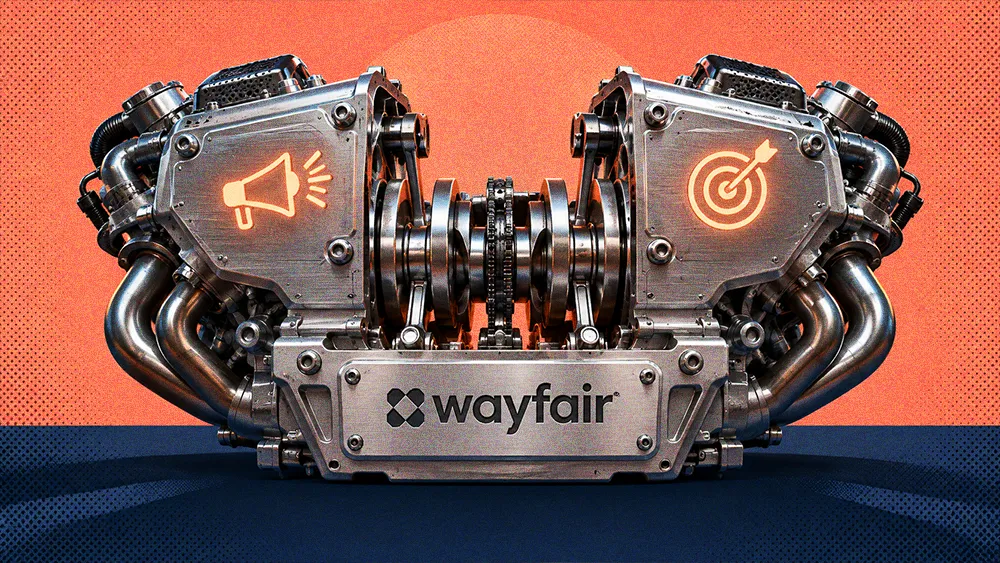
How Wayfair Treats Brand And Performance As Two Halves Of A Single Engine Driving Demand
Amanda Evans, Wayfair's Global Head of Brand, Insights & Partnerships, on making brand measurable enough to defend without reducing it to a number.
Make The CMO Wire one of your go-to sources on Google

Brand is a long game, but that doesn't give brand marketers permission to be vague about results.

As AI compresses creative timelines, the anxiety in most marketing organizations is that instinct and craft become casualties of speed. The teams navigating the shift well are reaching a different conclusion: better tools raise the value of human judgment rather than replacing it. The signals are faster and the testing is cheaper, but the job underneath hasn't changed.
Amanda Evans is the Global Head of Brand, Insights & Partnerships at Wayfair, where she leads brand and insights work inside a company built on performance marketing. That vantage point puts her at the exact seam where creative craft, measurement discipline, and AI-accelerated iteration meet.
"The more technology enters the creative process, the more important the human element becomes," Evans says.
More data, more room for instinct
The assumption Evans has most had to rethink in the AI era is that more data means less instinct. In her telling, the opposite has proven true: faster testing and better tools handle the parts of the process that used to consume weeks, which leaves more space for the fundamentally human work of understanding people.
She grounds that in how Wayfair's customers actually live. "Homes aren't showrooms. They're where real life happens. Kids do homework at the dining table. Pets become full-fledged family members." Great marketing, she asserts, starts from those realities rather than from the data alone. "The best marketers are still thinking like humans. We just have much better tools to validate, sharpen and amplify that thinking," Evans says.
Aligning brand and performance before the work starts
Making the case for brand inside a performance-wired company is a familiar challenge, but Evans rejects the notion of the two motives being at odds. "I actually don't think of it as brand versus performance. What's worked for us is getting brand and performance teams aligned up front on the business outcomes we're collectively trying to drive and how we'll know along the way whether we're making progress."
She leans on channel-specific Brand Lift Studies to track awareness, consideration, and preference, alongside signals like branded search, site behavior, and eventual conversion. In her model, brand and performance act as two halves of one engine. "Brand creates and strengthens demand; performance captures it," Evans notes.
That upfront alignment is what makes every downstream decision intentional. At Wayfair, customer research informs the whole chain, from insight and strategy through script, set, talent, and the media environment where the creative finally runs.
Right ad, right audience, right context
Evans has a favorite marketing failure: the commercial everyone remembers but no one can attribute to a specific company. Her framing of the stakes is blunt. "A great ad that nobody connects back to your brand is just expensive entertainment," she says.
For her, cognitive-response testing offers the means to move past what people say they liked toward where attention and emotion actually land, and an understanding of whether the brand shows up in the moments that matter. She points to Wayfair's work with Luma and Dumbstruck on measuring real emotional and cognitive response as a way to see those spikes and drop-offs directly.
But creative is only half the equation. "Content mapping matters just as much," Evans shares. "The best creative in the wrong environment can still underperform. We use data to think intentionally about the relationship between the story, audience, context and media environment rather than treating those as separate decisions." The goal isn't the best ad in the abstract, but the best ad for the right audience in the right context.
Measurable enough to defend, without becoming a number
Evans is candid about a tension that emotional measurement introduces: making brand measurable enough to defend without forcing it to justify itself entirely in the language of performance. Her resolution starts from a discipline she holds brand marketers to. "Brand is a long game, but that doesn't give brand marketers permission to be vague about results," Evans asserts.
She doesn't expect a Brand Health Tracker to jump every quarter or after every launch, but plenty of directional signals, like attention, ad recall, brand linkage, consideration, branded search, and eventually preference and loyalty, indicate whether the work is on the right path. The discipline is agreeing on the business outcome before the work is made, then pairing Brand Lift Studies, creative testing, and behavioral signals with longer-term brand health data. "We also make sure the economics make sense before production starts. If we're considering investing significantly in a piece of content, for example, we want confidence that we'll have enough media behind it to actually give the idea a chance to work," she says.
The steps worth protecting from speed
There are two things Evans deliberately shields from AI-enabled acceleration. The first is testing. "AI should help us move faster. It shouldn't give us permission to skip the steps that protect quality," she says. Wayfair stays rigorous about testing major video creative before market. What's changed is how quickly those signals arrive. "AI-enabled tools allow us to learn and iterate faster without lowering the bar."
The second thing is the power of storytelling. Technology can surface an insight or optimize an execution, she notes, but turning that into something a person actually feels still takes human empathy. "The best stories tend to come from very human, imperfect moments people recognize from their own lives." It's a perspective that mirrors how Evans sees the work itself: the tools keep getting faster and sharper, but the marketers who use them best are still the ones who never stop thinking like people.