
All articles
CMOs Cannot Personalize One Customer While The Retail Business Still Thinks In Channels
Sumit Srivastava, a luxury retail digital chief, on why organizing around channels costs retailers the customer, the two data sources most already own, and what AI unlocks.
Make The CMO Wire one of your go-to sources on Google

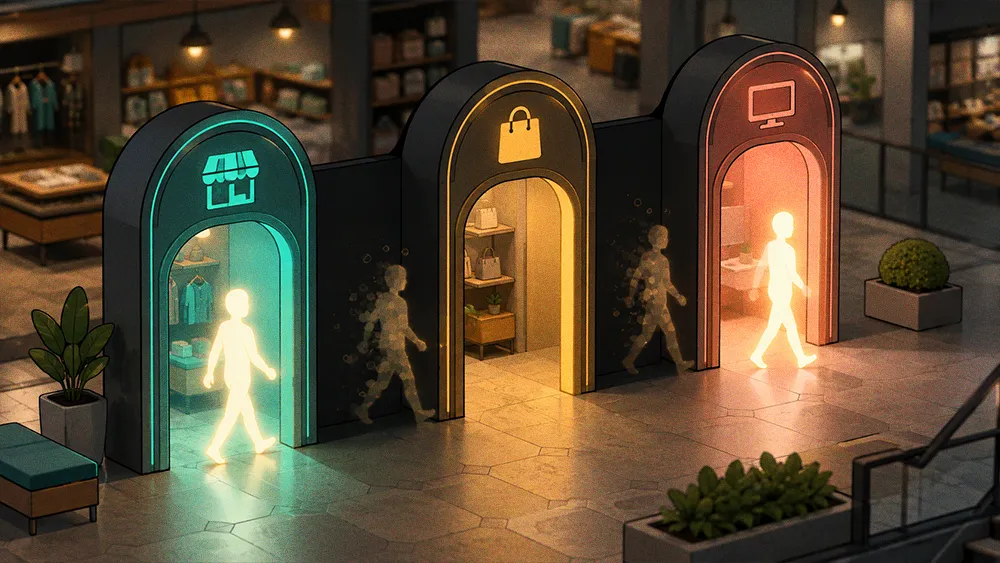
From the very get-go we shouldn't be thinking about stores versus online. They're both doors at the end of the day. They're just channels. A brand needs to be channel agnostic.

Most retailers still treat their stores and their websites as separate operations, with separate teams, separate targets, and separate ideas of who the customer is. The customer never experiences it that way. She checks a price on her phone, tries something on in a store, returns it through the app, and expects each of those systems to know what the others did. When they don't, the silos show up as friction she can feel: a payment that fails at checkout with no explanation, a store associate who has no idea what she bought online last month, a chatbot that answers "where's my order" and nothing else. None of those problems is really a technology failure, and one retail digital chief says the industry keeps misdiagnosing why they happen.
Sumit Srivastava is Chief Digital and Commercial Officer at a global luxury lifestyle retailer, with earlier stops at DoorDash, eBay, and Target, and a seat on the Forbes Technology Council. He has sat on both sides of the boardroom fight he describes, once as the young digital hire trying to convince a skeptical board that stores would eventually shrink into something more experiential. His argument now is that retailers spent years organizing themselves around channels, and that structural choice has become a customer-experience liability, one that AI is making harder to hide rather than solving on its own.
"Everybody will assign blame: 'We don't have the data, or the data is wrong, or we don't have the systems,'" says Srivastava. "I think more than anything, it's the mindset."
The customer is one person
The failure shows up in the space between channels. A shopper walks into a store as a stranger, even when she has a years-long purchase history sitting in the retailer's own database. "From the very get-go we shouldn't be thinking about stores versus online. They're both doors at the end of the day," he says. "They're just channels. A brand needs to be channel agnostic."
A sales associate greets a returning customer by name, references the dress she bought for a trip, asks how the trip went, and has a fitting room ready with pieces that complement it. That continuity is what makes a shopper feel known, and it is precisely what a retailer organized around channels cannot deliver, because the person helping her in the store has no idea what happened when she wasn't in the store. Srivastava traces the gap back to how most incumbents entered e-commerce, late and defensively, with store teams treating the digital side as an upstart threat. That habit hardened into an operating structure, and the structure now dictates the experience.
His answer starts at the top: leadership has to decide that the shopper is the organizing principle, not the channel. Once that decision is made, the systems work becomes much easier to prioritize, and the touchpoints that used to sit in separate columns, from loyalty to social to search, start feeding one picture instead of several. Without that decision, the cleanest data stack in the category still produces a fractured experience. It is the same fault line that keeps personalization stuck at segmentation when the organizing unit stays the channel instead of the individual moving through it.
Two data sources most retailers already own
Asked which connections would move the needle fastest for a retailer that is not especially advanced, Srivastava names two systems nearly everyone already has. The first is the loyalty program, which even at modest scale carries enough signal to reveal purchase frequency, basket composition, price sensitivity, and lifetime value. The second is customer service data, which he considers badly underused.
Every order generates a service record somewhere, because returns, cancellations, and questions all have to route through a system. Read together, those records expose which shoppers stay locked to a single channel and, more valuably, where the experience is actively failing. A stream of complaints about a slow site or a broken app is not noise to be closed out, he says. It is the clearest evidence a retailer has for why its digital business is stalling.
That can cost a retailer more than a single sale, and Srivastava is candid about what happens next: a frustrated online shopper does not get in the car and drive to the store, she buys the same bag from a competitor before the evening is over. "So not only have you lost Natalie online, you've lost her in store," he says, using the interviewer as his stand-in shopper. That service layer doubles as a live gauge of product quality, particularly for the private-label lines retailers pour money into, where ratings and complaint patterns reveal whether the investment is landing. It is the same instinct behind treating support as a churn signal, catching the warnings that slip past marketing before they cost a sale.
What AI actually unlocks once channels stop mattering
Srivastava has watched AI cycle through retail long enough to be impatient with the theatrics. He studied Geoffrey Hinton's works and research at the University of Toronto, when AI wasn't mainstream yet, and he sees much of what followed the consumer AI boom as gimmickry, the face-swap campaigns and novelty GIFs that generated curiosity and little else. His filter is unsentimental, and if an application cannot be tracked and measured against a benchmark, he does not trust that it adds value.
The returns show up once AI acts on customer signals the channel-based org used to trap. Intent-aware search reads a request for a gala dress as occasion, formality, and category at once, and surfaces evening wear rather than a random sundress. When the automated layer stalls, a live agent inherits the full conversation history instead of making the customer recite it again, the same continuity the store associate was missing, now rebuilt in software. The store side of that equation is moving too, as live inventory data finally lets an associate see what is in the back room and the store down the road. "From an AI perspective, it's not only ChatGPT or chatbots," he says. "Anything to do with robotics or machine learning or automation of those tasks is possible. Know the business outcome. Measure it to improve it."
That measurement bar is what separates real progress from the FAQ bots most retailers still mistake for conversational commerce. "Most retailers are building up their chatbots, which were first only FAQ-based," he says. "So all they want to do is, focus on 'Where's my order?' or 'How do I make a return?' And it's not even conversational. It's just clicks." For an industry heading into 2027, he considers that bar embarrassingly low. The technology itself is within reach for most retailers now. The harder problem is letting the customer's signals travel with her instead of stopping at a channel boundary.
The test every retailer can run tomorrow
For all the systems talk, Srivastava lands on something a CMO can act on without a data science team. The test is simple: walk through the experience as a customer and see what the retailer actually remembers about you. Where the site forgets your size, where the associate can't see your online history, where the third failed payment goes unexplained, those gaps show exactly where the org chart is showing through to the customer. Feed them back into the loyalty and service data he started with, and the fixes stop being guesswork.
Be the customer first, he says, not the retailer, because the customer does not care how the company is organized. She cares whether the experience worked. The retailers still arguing over which channel deserves more credit are answering a question their shoppers never asked. The customer moves through the retailer. The retailer's job is to stop making her move through its org chart.